
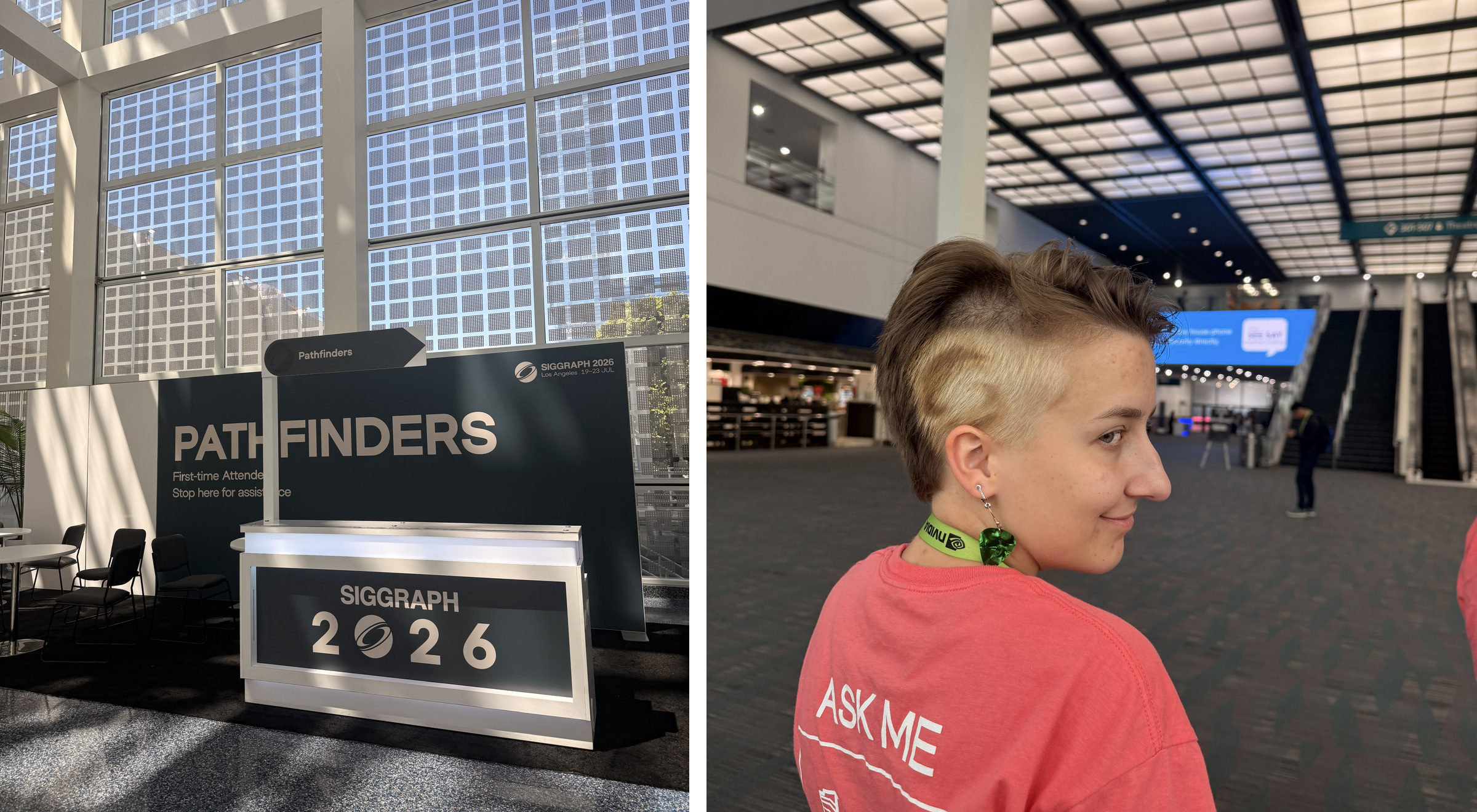
If you attended SIGGRAPH, you probably saw us before you knew who we were: the people in matching shirts answering questions, finding rooms, moving chairs, managing lines, and trying to make an enormous conference feel navigable. In 2026, I experienced that world as a Student Volunteer Team Leader and discovered how much of SIGGRAPH happens just outside the official program.
My week began before SIGGRAPH felt like a conference. The halls were still becoming themselves. Signs were going up, schedules were still theoretical, and everyone was learning the particular geography of a building that would soon hold thousands of people moving in every direction at once. On Friday night, the Team Leaders went to dinner. That was when I got to know Ju-ve, my TL buddy. He had years of SIGGRAPH experience; I had a head full of questions and the confidence of someone who had not yet worked her first seven a.m. shift lol.
The Student Volunteer cohort is small compared with the number of students who want to be part of it. You feel that rarity immediately, but not as prestige. You feel it as responsibility. Each person has a place in the machinery of the week, and if one part disappears, someone else has to absorb the motion.
A Team Leader spends the week holding an invisible map of the conference. I needed to know where every volunteer was assigned, what each location required, who needed a break, which rooms were about to fill, and how to solve problems that had not existed five minutes earlier. By the middle of the conference, I could carry most of the convention center in my head.
One afternoon, a group began setting up in a room staffed by volunteers, only for the presenters actually scheduled there to arrive a few minutes later. Suddenly, two groups believed the same room was theirs and the session was about to begin. We checked the schedule, moved the first group, reset the space, and helped the scheduled session start on time. Later, a hallway conversation grew loud enough to disrupt nearby sessions, so we redirected everyone to the networking area. None of this looked dramatic from the attendee's perspective, and that was exactly the goal.
Keeping the conference running also meant taking care of the people making it possible. I checked whether volunteers had eaten, had water, and had somewhere to sit between long shifts. Whenever I could, I introduced them to speakers in their rooms. Most introductions lasted less than a minute, but sometimes that tiny conversation gave a volunteer the confidence to return after the session and ask the question they had been holding all day.
I told the volunteers that “I don't know” could be a thought, but it should never be the answer we gave. We could say, “Let me check,” “Give me one second,” or “I'll find out.” Then we checked the schedule, asked another Team Leader, messaged the organizing team, or walked the attendee to the right place. We were not expected to know everything. We were expected to stay with the question until it was answered.
Leadership at SIGGRAPH was not standing at the center of the room. It was noticing who had been standing too long.
The Student Volunteer office had its own gravity. People clocked in, charged devices, played cards, traded stickers, doodled, and collapsed into chairs between shifts. I brought a thousand-piece New York Public Library puzzle on Wednesday, thinking it would be a background activity. Instead, it became a tiny institution. People leaned over it for five minutes and stayed for forty. New volunteers joined corners already in progress. By Thursday morning it was nearly finished, and everyone had a theory about the missing final piece. Pixel, our mascot, supervised the chaos, obviously.
The volunteer shirt also changes distance. It gives you a reason to say, “May I help you?” and at SIGGRAPH that can become a conversation with someone whose work has shaped your field longer than you have been studying it. I met Lanny Smoot before his keynote and told him what his work meant to entertainment, imagination, and technology. He redirected the attention to the volunteers: the conference happened because people were willing to serve it. Later, James Baxter visited the SV office. Somehow, people whose names usually live in credits or keynotes were standing beside the puzzle table.
There were private Student Volunteer sessions too, with artists, leaders, and recruiters from Walt Disney, Netflix, Wētā FX, the Avatar: Fire and Ash crew, and professors from MIT, USC, and NYU. One of my favorite tables belonged to a Women of SIGGRAPH conversation. Around it, the scale of the conference became personal: different paths, questions, doubts, and the feeling that there was room for all of us in this field.
SIGGRAPH 2023 was the first conference I had ever attended, somehow one of the world's biggest gatherings for computer graphics and also its 50th anniversary. I was in the first year of my master's degree and had no idea how much one week could rearrange the way I saw my field. In 2026, I returned as a Student Volunteer Team Leader, one year after graduating. The letters were the same. I was not.
Clocking out was mostly theoretical. After the shifts came Real-Time Live, the Electronic Theater, chapter gatherings, dinners, karaoke, late-night food, the RenderMan party, the Chapters Party, and the wrap party everyone kept talking about the next morning. On the final night, we went from karaoke to the organizers' wrap party and eventually to Taco Bell at one a.m. These people are my expensive friends. They live across countries, disciplines, and time zones, and seeing everyone usually requires another conference and another year.
The last day arrived before I was ready. I wrote personal notes and drew tiny doodles for the people I had worked with: the ones who stayed calm when a room became crowded, who arrived early, who needed encouragement, and who could make the office laugh after a difficult shift. Then the Exhibition Hall closed, the schedule became useless, and the convention center emptied with impossible speed. A week that had felt endless suddenly existed only in photos, lanyards, puzzle pieces, and one tiny walking teapot.
Being a Student Volunteer Team Leader was exhausting, funny, administrative, emotional, and occasionally ridiculous. It meant carrying a schedule and also carrying people through it. It meant being responsible enough to keep the work moving and human enough to understand that the puzzle, the sticker, the chair, the introduction, and the late-night meal were part of the work too. Proud to be SV.