
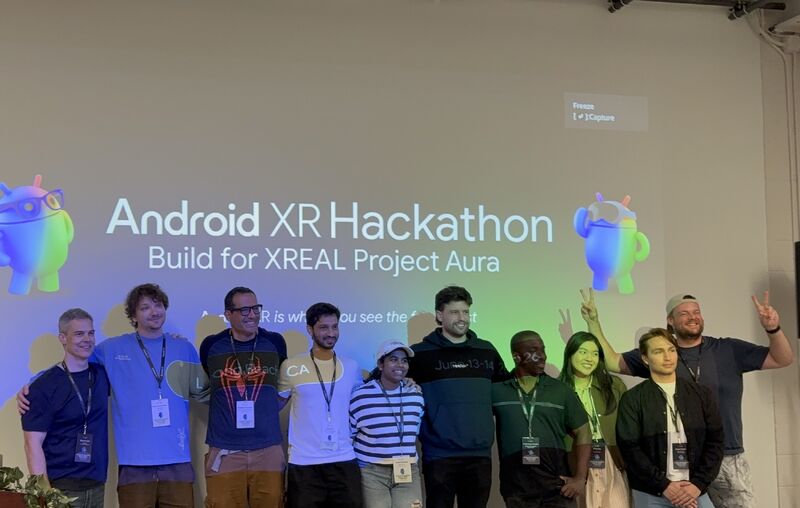
My first AWE is officially in the books. And wow... what a week!
Hackathon time is not real time. Forty-eight hours can somehow contain a new team, several discarded ideas, frantic debugging, a demo, and enough snacks to permanently alter your sleep schedule. By the time we reached the stage, the project felt much older than one weekend.
The win was incredible, obviously. But the part I keep returning to is how quickly a group of people can build trust when everyone is pulling toward the same demo. We found the idea, divided the unknowns, kept adjusting, and made the thing work under pressure. Then I walked into my first AWE already feeling like I had a community there.
for some of us the conference kicked off earlier last weekend with the Android XR Hackathon, where our team went from "wait, this idea could actually work..." to standing on stage as winners 48 hours later 😅
Huge thanks to the team Vinny, Grace, Randi, Thor, Benji, Hugo, and everyone involved, for creating such an incredible experience and giving developers the opportunity to experiment, build, and learn all while having fun.
Then AWE happened.
There were keynotes, demos, hallway conversations, startup booths, research discussions, after-parties, random encounters, and countless moments where I'd walk past someone and think: "Wait... I've cited their paper."
One thing that kept sticking with me throughout the week: The conversation is slowly shifting away from "Can we build this?" and toward "How does this actually make people's lives, work, learning, communication, and everyday experiences 100x better?"
The technology is getting better every year.
But the really interesting questions are becoming more human.
As someone who spent the last few years researching privacy, security, trust, analytics, and human behavior in XR, I loved seeing how many companies are taking those questions seriously.
A few things that stood out to me: > Even Realities taking a camera-free approach. > PICO XR's Secure MR initiative and focus on privacy. > Raven Resonance's physical camera covers. > SPECS emphasis on privacy indicators and building trust into wearable computing experiences.
It was refreshing to see privacy and trust treated as features instead of afterthoughts.
Thanks to Dr. Feiner, Dr. Gorlatova, Dr. @Cruz-Neira, Dilmer, Dinesh, Michael, Fay Yu, and so many others for the conversations, advice, and inspiration.
This is still one of the threads running through almost everything I build: useful technology should not require people to surrender more of themselves than the experience truly needs. Privacy is not a final checkbox. It is part of the product architecture.