
Aava
An AI merchandising assistant that turns a few product photos and a conversation into listings, pricing ideas, SEO tags, captions, and campaign-ready content.
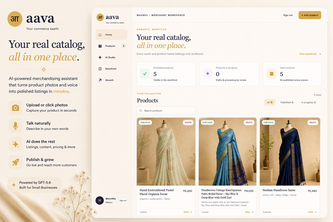
Growing up around my family’s saree business made the problem very real: selling one item online is rarely one task. It is photography, editing, copywriting, competitor research, pricing, hashtags, and publishing—repeated for every product.
Inside the experience
What someone can actually do
- Upload casual product photos
- Describe a product through voice or text
- Ask clarifying questions instead of hallucinating details
- Generate descriptions, prices, SEO tags, hashtags, and campaign content
- Prepare publishing workflows for online stores and social channels
How the idea took shape
Aava turns that chain into a conversation. The model can see the product, reason about what it knows, and ask for the missing detail instead of quietly inventing one. That trust boundary mattered as much as the content generation.
Although the demo centers on fashion, the workflow can extend to jewelry, handmade products, furniture, food, and other small businesses that need a marketing team long before they can afford one.
“A useful AI product is not one clever prompt; it is a workflow that knows when to ask rather than assume.”
Explore how it was built +
I brought firsthand small-business context into the product, co-designed the end-to-end workflow, and helped shape the multimodal merchandising and marketing experience.
- GPT-5.6
- ChatGPT
- Codex
- Sora
- Whisper
- Multimodal AI
Where it could go next