
I first started thinking seriously about virtual kinetic art while looking at Reuben Margolin’s Helix Wave at the Museum of Discovery in Little Rock. It is beautiful: this huge suspended system that turns mechanics into something almost alive. But I also had the very normal urge to get closer, see what was actually happening, and maybe touch something I definitely was not allowed to touch.
That distance is part of the reality of kinetic sculpture. In a museum, the work has to be protected. In a studio, it has to obey materials, weight, space, safety, and money. Every experiment can mean rebuilding a physical structure. A slightly different motion is not a slider; it is another round of fabrication. The constraints can be creatively useful, but they can also stop an idea before it has room to become interesting.
So I kept coming back to one question: what if the sculpture could live somewhere that did not have to follow all of those rules yet? What if I could pause its motion, change gravity, speed it up, slow it down, and walk around the mechanism while it was still only an idea? That question became a small VR pendulum model, and eventually the larger idea I call a virtual studio.
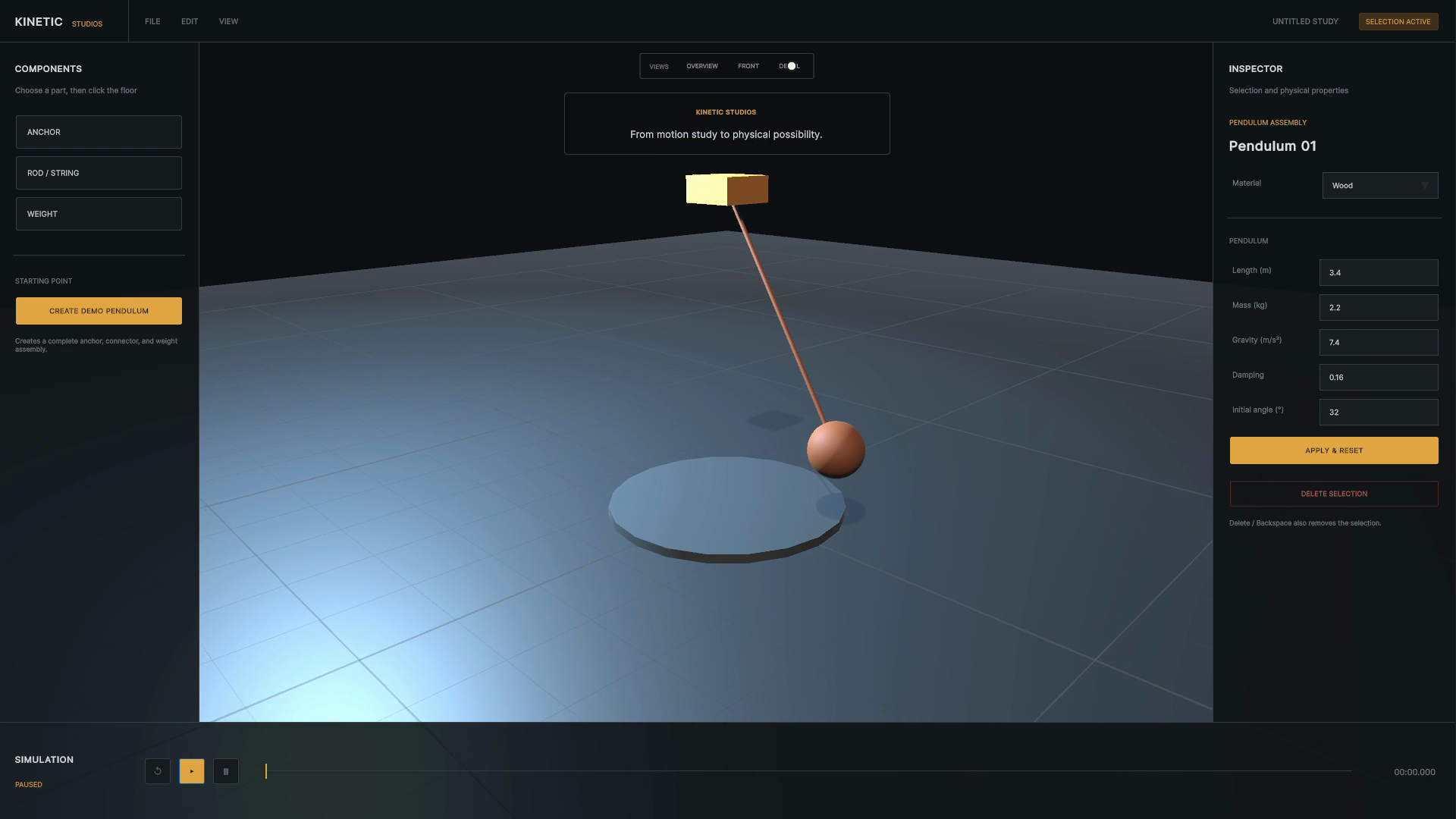
The prototype is intentionally simple. A user can pause and resume the pendulum, change the gravity and speed, and look at it from several viewpoints. Those controls sound tiny on paper. Inside an immersive space, though, they change your relationship to the object. You are no longer watching physics happen from a polite distance. You are poking at the rules and immediately seeing what changes.
That is the part I love. Inertia, momentum, and oscillation stop being formulas waiting on a page and become things you can feel your way through. Lower gravity and the movement stretches out. Change the speed and the character of the sculpture changes with it. Move your own body and a mechanism that looked confusing from one angle suddenly makes sense from another. The viewer becomes a participant, and, for a moment, a collaborator with the artist.
A virtual studio could make this loop much bigger. Artists could test impossible combinations before committing to material. Designers could compare motion systems in real time. Scientists and students could explore the same object from completely different questions. And because the environment is simulated, it can support ideas that are impractical, expensive, or gloriously unhinged in the physical world. Zero-gravity sculpture? Fine. A pendulum moving through a force field that does not exist? Also fine. We can figure out whether it is compelling before figuring out whether it is buildable.
This way of thinking owes a lot to Dr. Carolina Cruz-Neira’s CAVE system. The CAVE showed that immersive computing could move interaction off a flat screen and into the space around a person. That shift matters to me because kinetic art is already spatial. Its meaning lives in scale, viewpoint, rhythm, and the relationship between your body and a moving object. VR is not just a convenient place to display it; it can become part of how the work is understood and made.
There is also a practical sustainability argument here. Physical prototyping consumes material, creates waste, and often requires specialized space. A virtual pass does not replace the final sculpture, and I would not want it to, but it can help an artist make better decisions before fabrication begins. Fewer blind rebuilds, more intentional experiments, and a clearer sense of what deserves to exist physically.
The educational possibility might be even more exciting. A learner who cannot access a specialized lab or museum could still stand beside a moving model, manipulate it, and observe the consequences. Instead of being told how a law of motion behaves, they get to form a guess and annoy the pendulum until it proves them right or wrong. That is a much stickier kind of learning.
Kinetic Studios started as a way to prototype motion, but it keeps turning into a bigger question about creative tools: what becomes possible when the tool does more than imitate a physical studio? The best virtual studio is not a cheaper copy of a real room. It is a place where we can think with motion, bend the rules for a while, and return to the physical world with a better idea than the one we started with.